Founding Five — 5 of 5 slots open

We'll build your Shopware 6 store. Free.

We are a Shopware Gold Partner with 15+ years in ecommerce. For five complex-commerce and B2B brands on Magento or BigCommerce, we will cover the entire replatform as a service: build, data migration, B2B configuration and launch. We are running it together with Shopware, and you pay only third-party costs: your Shopware plan, your hosting and any software licences.

No cost to apply. Every applicant gets a written migration readiness audit, slot or no slot.

0

Records lost — every field mapped and validated in staging

1:1

URL redirect map, built from your live crawl before cutover

Minutes

Downtime at cutover, with a documented rollback path

90 days

Post-launch SEO and ranking monitoring included

Where you are today

Both roads end at Shopware 6. The reason for taking them is completely different, so find the one that describes your store.

Unpatched right now

Magento / Adobe Commerce

If you run Magento Open Source 2.4.5 or 2.4.6, you are past end of support with no extension available. That is a live PCI DSS problem and a growing breach exposure, not a future one. Meanwhile Adobe keeps narrowing the Open Source path to push merchants toward its managed cloud.

The upside: Shopware shares Magento's open-source PHP heritage and a B2B-first data model, which makes this the cleanest migration route off Magento, and far cleaner than a jump into closed SaaS.

Audit my Magento store

Hitting the ceiling

BigCommerce

BigCommerce is solid until your commerce gets complicated. Then you meet the ceiling: you cannot own or self-host the code, pricing tiers step up with your sales volume, API limits and checkout constraints start dictating your roadmap, and serious B2B capability arrives as a paid edition or a stack of third-party apps.

Shopware puts negotiated pricing, quotes and approval workflows in an open core you control, and lets you host where your data needs to live.

Audit my BigCommerce store
Amandeep Singh, President and Solutions Architect at Cronix, speaking on a panel
Amandeep Singh President & Solutions Architect, Cronix

Why we are running this with Shopware

Replatforming is expensive and it frightens people, with good reason. I have sat with a lot of merchants who knew their platform was holding them back and stayed on it anyway, because the migration looked like a bill they could not justify next to a risk they could not model. So the business stops growing. Not because of the market, but because of the software underneath it.

That is the problem this promotion exists to remove. We are running it together with Shopware, for the first five eligible merchants, and we cover the work. Five is not a marketing number. It is how many my team can do properly at the same time without the quality slipping.

I have been in ecommerce for more than 15 years. This industry taught me the trade and it is the reason Cronix exists, so part of this is simply giving something back to a community I owe a great deal to. I would rather spend it on five merchants getting unstuck than on advertising.

And if it goes the way I expect it to, we will have something worth writing up together at the end of it.

Talk to me directly: contact@cronixweb.com  ·  +1 (213) 808-3122

Standing still is the expensive option

Legacy platforms rarely fail in a way that forces your hand. They just get more expensive every quarter until a breach or a licence deadline makes the decision for you. Six ways that shows up on your P&L.

  1. Security and compliance debt

    An unsupported platform undermines your PCI DSS position and widens your breach exposure. When Magento 1 reached end of life in 2020, thousands of stores were compromised in coordinated campaigns that specifically targeted known-unpatched versions. Open Source 2.4.x sits in that same position today.

  2. Cost that scales against you

    Volume-banded SaaS pricing, transaction fees and the extension-maintenance tax all mean your platform gets more expensive precisely as you succeed. Shopware's open-source core carries no revenue share and no forced transaction fee.

  3. Ownership you are quietly losing

    On closed SaaS you rent your storefront. On Adobe's roadmap, each step tightens the lock-in. Shopware keeps the code in your hands, self-hosted or cloud, with EU data residency available if you need it.

  4. A roadmap you do not set

    When negotiated pricing, approval chains or ERP-driven catalogues need workarounds, your engineering budget goes on fighting the platform instead of on selling. Complex commerce needs a core that already thinks in B2B.

  5. Talent that keeps getting scarcer

    Specialists for aging platform versions get harder to hire and more expensive every quarter, and the ones who stay are maintaining rather than building.

  6. The rushed-migration premium

    A migration forced by a breach or a deadline costs more, ships worse, and puts your organic traffic at real risk. A planned one with a validated redirect map does not.

In good company

Serious companies already run complex commerce on Shopware

Global manufacturers, wholesalers and B2B distributors chose Shopware for the reasons you are weighing up: negotiated pricing, deep catalogues, ERP-driven operations and code they control. Shopware publishes their stories, by industry, with real numbers.

See Shopware's customer stories (opens in a new window)

Magento and BigCommerce, side by side with Shopware 6

Shopware does not win on raw feature count against a mature SaaS incumbent. It wins on ownership, B2B depth and a cost model that does not punish growth. Here is where that actually shows up.

Feature comparison: Magento Open Source, BigCommerce and Shopware 6
Dimension Magento Open Source BigCommerce Shopware 6
Security and support 2.4.5 and 2.4.6 past end of support — no further patches Patched by the vendor, but on the vendor's timetable Actively maintained open source on a current, supported release
Code ownership You own the code, but the supported path narrows toward Adobe Cloud None — you cannot self-host or fork the platform Open-source core; self-host or use Shopware Cloud, your choice
Cost model Free licence, but rising extension and maintenance burden Plan tiers that step up with online sales volume No revenue share and no forced transaction fee on the core
Native B2B Bolted on, custom built, or reserved for the paid tier A separate B2B edition plus third-party apps B2B Components in the core: individual pricing, quotes, approvals, org units
Complex catalogues Capable, but upgrade-fragile once heavily customised Constrained by platform API limits and template rules Rule Builder and Flow Builder for pricing and process logic without custom code
Checkout control Full control, at the cost of ongoing maintenance Limited — deep checkout changes need higher tiers Fully customisable, including B2B invoice and net-terms flows
Data residency Entirely down to your hosting stack The vendor's infrastructure and regions only Host where you need to; EU residency and GDPR alignment available
Architecture Monolith with a heavy, rebuild-style upgrade path SaaS core with headless available via API API-first; go composable with Shopware Frontends when you want to
ERP and CRM fit Mature connectors, heavy integration maintenance App-marketplace connectors with limited depth Direct connectors for SAP, Dynamics, NetSuite, Odoo and HubSpot

Comparison reflects Magento Open Source and standard BigCommerce plans as of August 2026. Your audit confirms exactly where your own edition and configuration sit.

The Founding Five

What you get, and what it costs you

For the first five eligible merchants, our entire service fee is zero. That only works if both sides know precisely where the line sits, so we publish our boundaries up front rather than letting anyone discover them halfway through.

$0Cronix service fee

What we cover, end to end

  • Full Shopware 6 store build on a premium theme, designed around your catalogue
  • Complete data migration: products, variants, customers, orders, categories, content
  • B2B Components configuration — customer groups, individual pricing, quotes, approvals
  • Standard ERP and CRM connector configuration (SAP Business One, Dynamics, NetSuite, Odoo, HubSpot)
  • 1:1 URL redirect map with 301s, validated in staging before cutover
  • Payment and shipping method configuration, including B2B invoice and net terms
  • Managed launch: cutover at a low-traffic window with a documented rollback
  • 90 days of post-launch SEO, ranking and error monitoring
  • Team handover and admin training session

5 of 5 slots open

Apply for a founding slot

Not included — be clear on this

What you pay for directly

These go to third parties, not to us. We will not mark them up or resell them.

  • Your Shopware plan or licence (Rise, Evolve or Beyond)
  • Hosting and infrastructure costs
  • Third-party plugin, extension and app licence fees
  • Payment provider accounts and their fees
  • Domain, SSL, CDN and email service costs
  • Product photography and content or copywriting

What we hope for in return is a store worth talking about: a case study we publish together, and a reference call for future clients.

Who this is for

We are deliberately narrow about fit. A store that would be well served by a template install is not the right use of a slot, and we would rather tell you that in week one than in month three.

Strong fit

  • Currently on Magento / Adobe Commerce or BigCommerce
  • Meaningful B2B or wholesale revenue — or launching it
  • Complex commerce: negotiated pricing, tiered or contract pricing, large or attribute-heavy catalogues, multi-warehouse, or multi-store
  • An ERP or CRM that the storefront has to talk to
  • A decision-maker who can commit to a 10–14 week timeline
  • Happy to be named in a case study if the launch goes well

Not a fit right now

  • Pure DTC with a small, simple catalogue
  • Already on Shopware — but talk to us about optimisation work anyway
  • Needs a fully headless custom frontend from day one
  • Cannot be named publicly under any circumstances
  • Needs to be live in under six weeks

Not a fit for a free slot? The migration readiness audit is still free, and we will quote the work honestly if you want it done.

This is configuration, not a development project

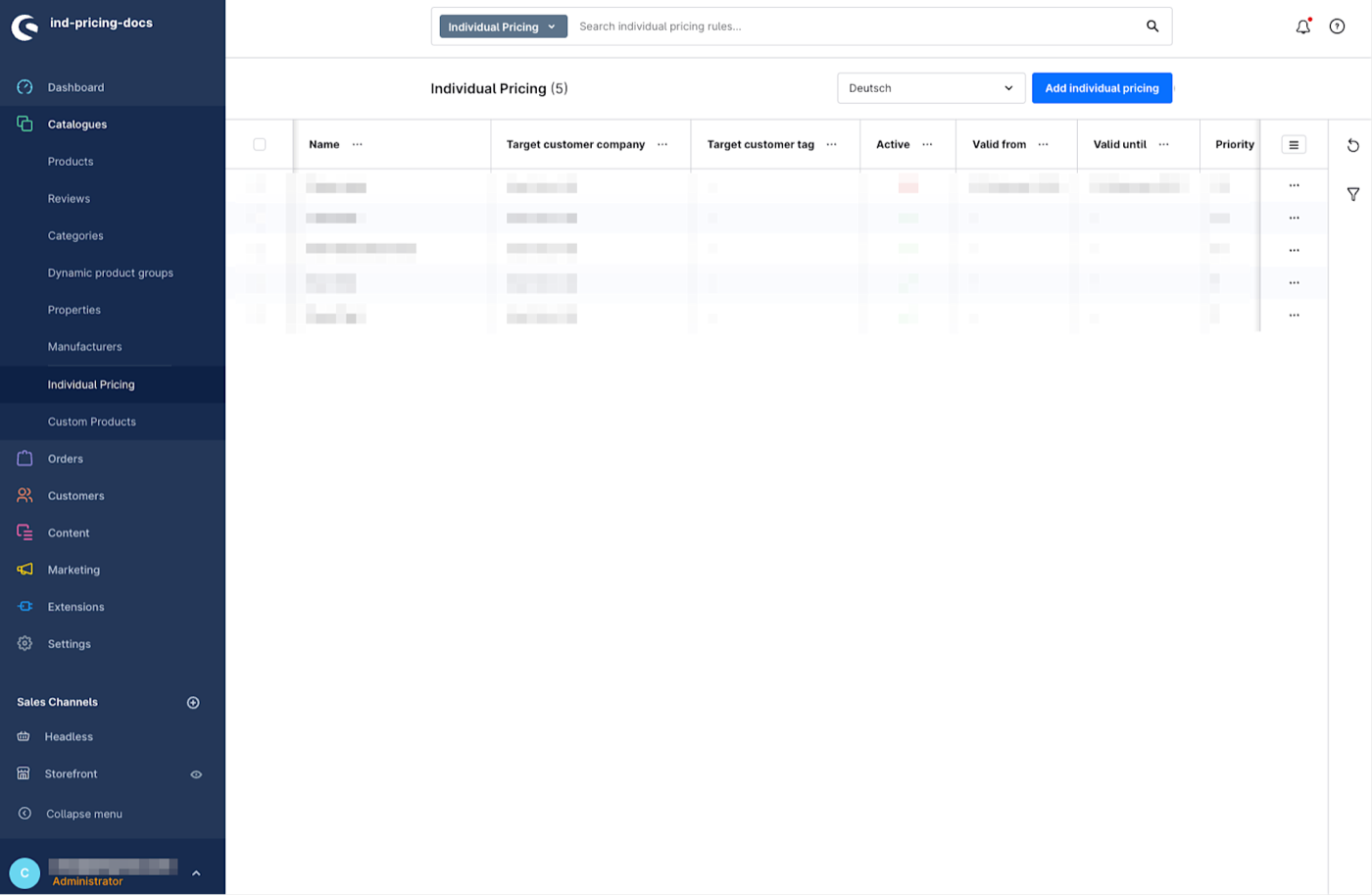
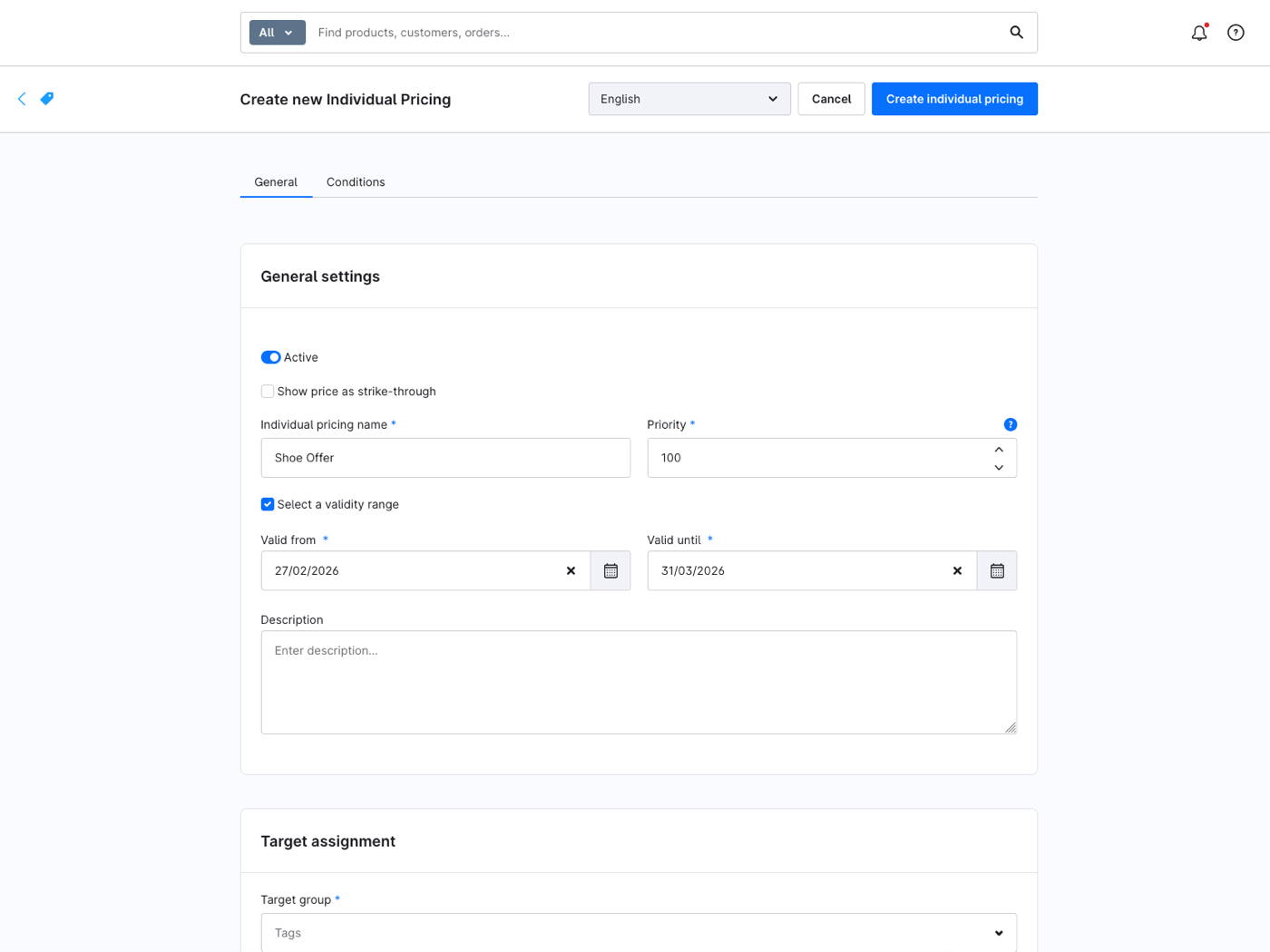
On most platforms, the list below is a quote with a delivery date attached. In Shopware 6 it is an afternoon in the admin. That single difference is the whole argument for moving, so here is what it looks like in practice.

The Shopware 6 admin listing Individual Pricing rules, with columns for target customer company, target customer tag, validity dates and priority
Customer-specific price lists, managed as rules with their own validity windows and priority. No plugin, no custom table.
The Shopware 6 admin form for creating an Individual Pricing rule, showing validity range, priority and target group assignment
Building a contract price: pick the target group, set the window, set the priority. This is the screen that replaces a bespoke pricing engine.

Screenshots: Shopware 6 administration, via Shopware's own documentation.

In Shopware's B2B Components

Individual pricing
Customer-specific and contract pricing, tiered and quantity breaks, per customer or per group.
Quote management
Buyers request a quote, your team negotiates line by line, the customer accepts and it becomes an order.
Approval workflows
Orders over a threshold route to the right approver on the buyer's side before they are placed.
Organisation units
Parent accounts, sub-accounts, departments, budgets and role-based permissions.
Quick order and reorder
SKU-and-quantity bulk entry, CSV upload, saved lists and one-click reorder. How procurement teams buy.

In the Shopware core

Rule Builder
Compose pricing, shipping, payment and promotion rules from customer, cart and catalogue conditions.
Flow Builder
Automate order status triggers, ERP handoffs, notifications and internal tasks, visually.
Invoice and net terms
Pay-by-invoice and net-terms flows configured properly, because that is how your buyers expect to pay.
Multi-store and multi-currency
Several sales channels, currencies, languages and price lists from one admin and one catalogue.
API-first architecture
Go composable with Shopware Frontends when you want to, without re-platforming again.

How the five stages run

A replatform goes wrong when the plan lives in someone's head. Every stage here produces a document you sign off on, so there is never a surprise at cutover.

Readiness audit

A written diagnostic in about five business days: edition and security exposure, data volumes and quality, integration inventory, B2B requirements and your full SEO footprint.

Migration blueprint

Field-by-field data mapping, the 1:1 redirect map, B2B configuration plan, integration plan and timeline. You review and approve it before any code is written.

Build and configure

The Shopware 6 store is built on staging, B2B Components configured to your blueprint, and connectors wired to your ERP or CRM.

Validate

Record-level data reconciliation, redirect testing, checkout and payment testing across your customer groups, and your own team's UAT. Never in production.

Launch and monitor

DNS cutover at a low-traffic window with a documented rollback, then 90 days of SEO, ranking and error monitoring, plus handover and admin training.

Shopware Gold Partner

Check us out before you commit to anything

Cronix is a Shopware Gold Partner, a tier Shopware awards on certified staff and delivered projects rather than on marketing spend. Our team holds Shopware 6 Certified Developer, Certified Advanced Template Designer and Trained Solutions Architect certifications. All of it is on our listing in Shopware's partner directory ↗, published by Shopware, not by us.

Fifteen years in ecommerce, hundreds of builds and migrations across platforms, and a reference call available on request. Ask us for one before you commit to anything.

Find out where you stand

Eight questions. The first four also tell us whether you qualify for one of the five founding slots. Either way you get a written migration readiness audit at no cost and with no obligation.

  • Written migration readiness audit, delivered in about five business days
  • Edition and security exposure check — Open Source versus licensed
  • Data volume, quality and complexity assessment
  • B2B requirement fit against Shopware's native capability
  • Legacy-versus-Shopware total cost of ownership estimate
  • A straight yes or no on the founding slot — no drawn-out sales process

Questions we get asked every time

What's the catch? Why is this free?

Two reasons. We are running this promotion together with Shopware, and we think the merchants who most need to move are often the ones least able to justify the cost of moving. After 15 years in this industry, funding five of those migrations is a better use of our money than advertising. You get the replatform without our service fee, and we hope to get a store worth writing up together at the end of it. You still pay third parties directly, meaning your Shopware plan, hosting and any software licences, and we take no cut of those.

Will I lose my search rankings?

No. Every migration ships with a 1:1 URL redirect map and 301s built from a crawl of your live site, tested in staging before DNS moves. We then monitor rankings, organic traffic and crawl errors for 90 days after launch and act on any drift. Protecting organic revenue is a stage in the plan, not an afterthought.

Is my data safe during the migration?

Products, variants, customers, order history, categories and metadata are mapped field-by-field and reconciled record-by-record in a staging environment. Nothing is transformed in production, and your existing store keeps running untouched until you approve the cutover.

How long does it take, and what do you need from us?

Plan on 10–14 weeks from signed blueprint to launch for a complex B2B catalogue. From your side we need one empowered decision-maker, access to your current platform and ERP or CRM, and a few hours a week for reviews and UAT. Slow feedback loops are the single biggest cause of migration delays.

Will my store go down at cutover?

We switch DNS during a low-traffic window with a documented rollback path. In practice downtime is measured in minutes rather than hours, and if anything looks wrong on the way through we roll back instead of pushing on.

Self-hosted or Shopware Cloud — which do I need?

That is one of the things the audit decides. Self-hosting gives you maximum control, code ownership and data-residency choice. Shopware Cloud removes the infrastructure overhead. Because the core is open source you are not locked into either. You can start one way and move later, which is not true of the SaaS platform you are on now.

Do I really get native B2B without custom development?

The essentials, yes. Shopware's B2B Components cover customer-specific and tiered pricing, quotes, order approvals, budgets, quick order and organisation units in the core, and the Rule Builder handles a lot of pricing logic that would otherwise be code. Genuinely unusual requirements can still need development, and the audit tells you which bucket you are in before you commit to anything.

What happens after launch? Are we on our own?

The free scope includes 90 days of SEO, ranking and error monitoring plus a handover and admin training session, so your team can run the store. Ongoing development or a retainer is entirely optional and quoted separately. There is no obligation attached to a founding slot.

What if we don't get one of the five slots?

You keep the written migration readiness audit at no cost. It is useful even if you replatform with somebody else, or stay put. If you want the work done, we will quote it transparently against the same scope. And we will tell you straight away rather than leaving you waiting.

Are you a Shopware partner?

Yes. Cronix is a Shopware Gold Partner, which Shopware awards on the number of certified staff and delivered projects. Our team holds Shopware 6 Certified Developer, Certified Advanced Template Designer and Trained Solutions Architect certifications. You can verify all of it independently on our listing in Shopware's partner directory, and we will set up a reference call before you sign anything.

Tomorrow your store is one day older and no safer

Five founding slots. One free audit either way. The only thing that gets more expensive from here is waiting.

Apply for a founding slot